
DADGAD tuning tunes your strings to D A D G A D, from lowest to highest. You lower strings 1, 2, and 6 by one whole step (two semitones) from standard tuning, leaving strings 3, 4, and 5 unchanged. Strummed open, DADGAD spells a Dsus4 chord. This provides a resonant modal drone across Celtic, fingerstyle, folk, and ambient rock guitar. The tradeoff is that standard open chord and barre shapes no longer work, and lower string tension can cause fret buzz without proper gauge selection. This guide shows you how to tune safely, play essential open voicings, map D Dorian, Major, and Minor scales, and balance your string setup.
DADGAD tuning notes
In standard tuning, your strings run E A D G B E. To enter DADGAD, you lower three strings and keep three strings unchanged:
Scroll sideways to see all columns.
| String | Standard | DADGAD | Change | Interval to next string |
|---|---|---|---|---|
| 6 (lowest) | E | D | −2 semitones | Perfect fifth (7 semitones) |
| 5 | A | A | Unchanged | Perfect fourth (5 semitones) |
| 4 | D | D | Unchanged | Perfect fourth (5 semitones) |
| 3 | G | G | Unchanged | Major second (2 semitones) |
| 2 | B | A | −2 semitones | Perfect fourth (5 semitones) |
| 1 (highest) | E | D | −2 semitones | None |
Notice the unique symmetry: strings 6, 4, and 1 are all tuned to D across three octaves (D2, D3, D4), while strings 5 and 2 are both tuned to A across two octaves (A2, A3). The middle 3rd string is G, the suspended fourth.
How to tune your guitar to DADGAD
- Tune string 6 down to D: Play your open 4th string (D) as a reference and lower the 6th string until they are an octave apart.
- Keep strings 5, 4, and 3 standard: Leave string 5 at A, string 4 at D, and string 3 at G.
- Tune string 2 down to A: Play your open 5th string (A) as a reference and lower string 2 until they match in octave pitch.
- Tune string 1 down to D: Play your open 4th string (D) as a reference and lower string 1 until they resonate cleanly an octave apart.
- Check open harmonics and settle: Touch the 12th-fret harmonic on strings 6, 4, and 1. They should ring in clean unisons and octaves. Play for a minute and recheck your tuning as neck tension settles.
What changes on the fretboard
Lowering three strings by a whole step breaks standard open chord grips. In exchange, DADGAD gives you sympathetic resonance and three structural advantages:
- Symmetrical octave pairs: Any fret you play on string 6 produces the exact same note at that same fret on string 4 and string 1. Strings 5 and 2 also share identical fret notes across the entire neck.
- Modal flexibility: The open tuning contains no third (neither F nor F#), making it open to both major and minor tonalities. Fret a single note while letting the other five strings drone to establish your scale.
- Movable two-finger grips: Slide simple two-finger shapes up the neck over ringing D and A strings to produce rich extended chords.
Essential open chords in DADGAD
DADGAD lets you voice full chords with minimal finger movement. These essential open voicings keep maximum open-string resonance:
Scroll sideways to see all columns.
| Chord | Strings/frets (6 to 1) | Notes | Why it works |
|---|---|---|---|
| Dsus4 | 0-0-0-0-0-0 | D-A-D-G-A-D | All open strings ringing in natural suspension (root, fifth, octave, fourth). |
| D5 (Power) | 0-0-0-2-0-0 | D-A-D-A-A-D | Fretting the 3rd string at fret 2 replaces the 4th (G) with a 5th (A), spelling pure root and fifth. |
| D Major | 0-0-0-2-0-4 | D-A-D-A-A-F# | Adds the major third (F#) on the high 1st string while retaining the full open D-A drone below. |
| D Minor | 0-0-0-2-0-3 | D-A-D-A-A-F | Places the minor third (F natural) on fret 3 of string 1 for an instant, haunting D minor sound. |
| Gadd9 / Gsus2 | 5-5-0-0-0-0 | G-D-D-G-A-D | Fretting strings 6 and 5 at fret 5 gives a massive open G voicing with ringing A and D overtone extensions. |
| A7sus4 | x-0-2-0-0-0 | x-A-E-G-A-D | A lush dominant suspension built with a single finger on the 4th string at fret 2. |
| Asus4 / A5 | x-0-2-2-0-0 | x-A-E-A-A-D | Two fingers at fret 2 on strings 4 and 3 create a ringing Celtic transition chord. |
| Bm7 | x-2-0-2-2-0 | x-B-D-A-B-D | A rich B minor voicing that carries the key of D with open D and string 2 B resonance. |
| Cadd9 | x-3-2-0-3-0 | x-C-E-G-C-D | Natural ♭VII chord for folk and Celtic progressions in D modal keys. |
Scales and modal maps for DADGAD
Because strings 6, 4, and 1 share the root note D, D-rooted scales are exceptionally easy to map. You can play melodies across the high strings while rhythmically bouncing off the open low D and A bass strings.
1. D Dorian (The Celtic and Folk Lead Scale)
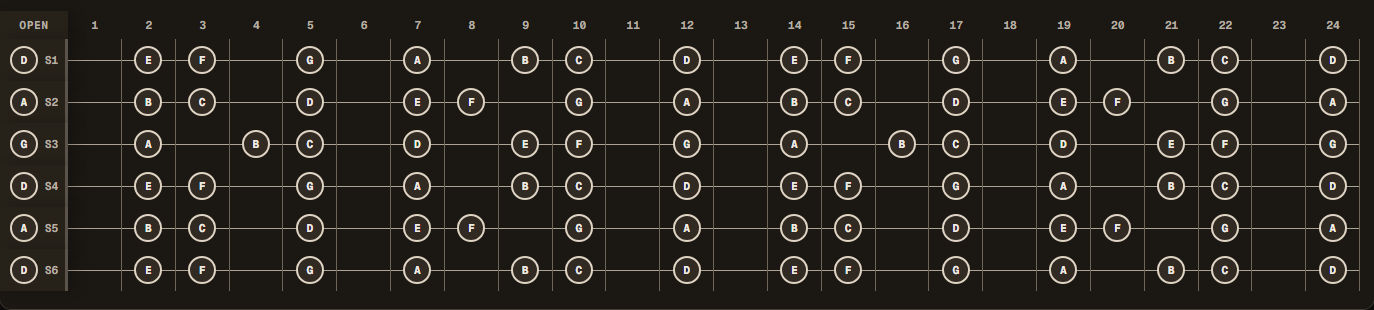
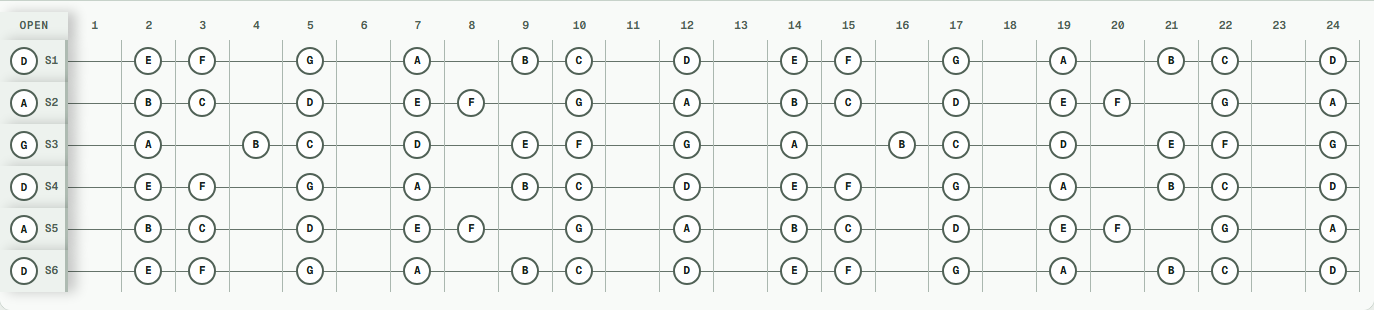
D Dorian (D, E, F, G, A, B, C) is the most popular mode in Celtic, Irish, and folk guitar. It features a minor third (F) paired with a natural sixth (B), producing a melancholy yet uplifting modal sound without the dark tension of natural minor.
- Strings 6, 4, 1 (D): Fret 0 = D, fret 2 = E, fret 3 = F, fret 5 = G, fret 7 = A, fret 9 = B, fret 10 = C, fret 12 = D
- Strings 5, 2 (A): Fret 0 = A, fret 2 = B, fret 3 = C, fret 5 = D, fret 7 = E, fret 8 = F, fret 10 = G, fret 12 = A
- String 3 (G): Fret 0 = G, fret 2 = A, fret 4 = B, fret 5 = C, fret 7 = D, fret 9 = E, fret 10 = F, fret 12 = G
→ Explore D Dorian in the DADGAD visualizer
2. D Major (Ionian)
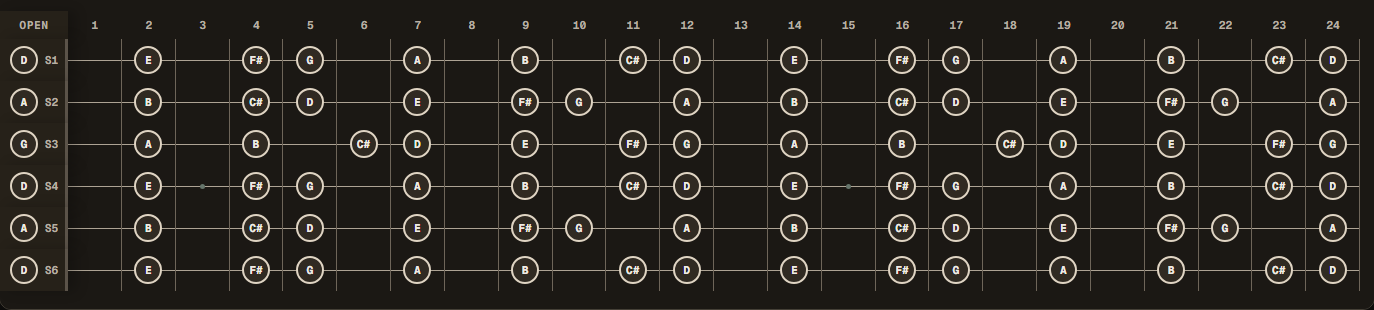
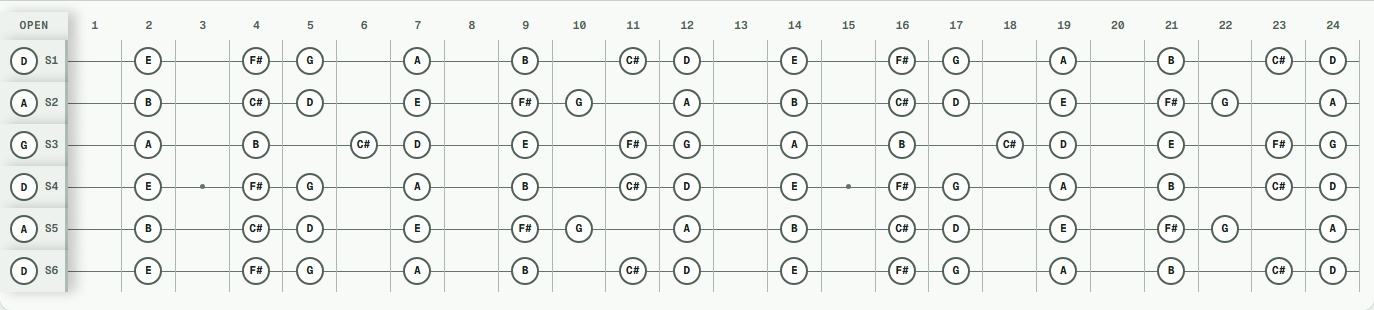
D Major (D, E, F#, G, A, B, C#) is the home key for acoustic fingerstyle arrangements, hymns, and traditional fiddle tunes. In DADGAD, the open strings naturally reinforce the tonic (D), dominant (A), and subdominant (G).
- Strings 6, 4, 1 (D): Fret 0 = D, fret 2 = E, fret 4 = F#, fret 5 = G, fret 7 = A, fret 9 = B, fret 11 = C#, fret 12 = D
- Strings 5, 2 (A): Fret 0 = A, fret 2 = B, fret 4 = C#, fret 5 = D, fret 7 = E, fret 9 = F#, fret 10 = G, fret 12 = A
- String 3 (G): Fret 0 = G, fret 2 = A, fret 4 = B, fret 6 = C#, fret 7 = D, fret 9 = E, fret 11 = F#, fret 12 = G
→ Explore D Major in the DADGAD visualizer
3. D Natural Minor (Aeolian)
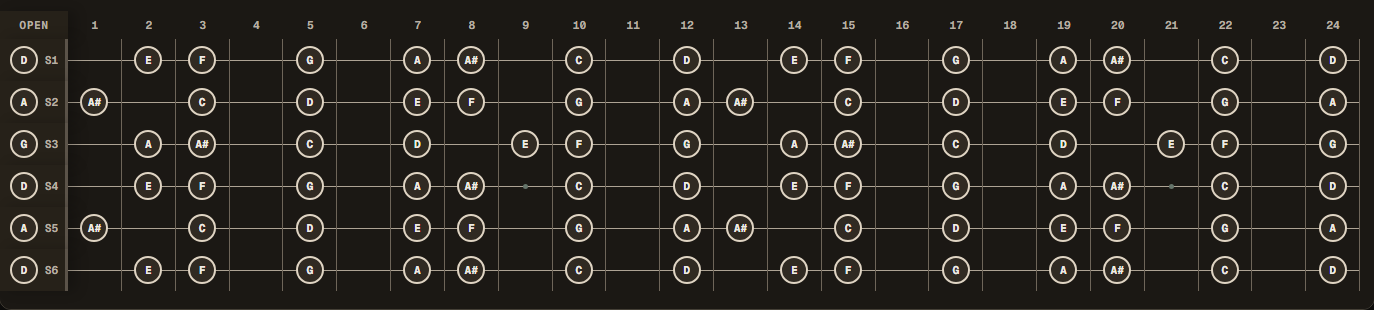
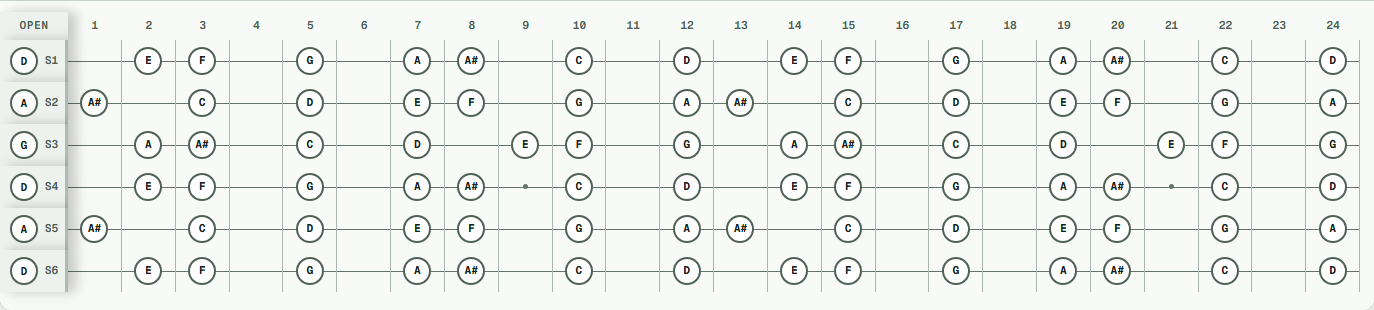
D Natural Minor (D, E, F, G, A, B♭, C) provides a somber, cinematic atmosphere. The flat sixth (B♭) appears at fret 8 on the D strings and fret 1 on the A strings, allowing for rapid pedal-point ostinatos.
- Strings 6, 4, 1 (D): Fret 0 = D, fret 2 = E, fret 3 = F, fret 5 = G, fret 7 = A, fret 8 = B♭, fret 10 = C, fret 12 = D
- Strings 5, 2 (A): Fret 0 = A, fret 1 = B♭, fret 3 = C, fret 5 = D, fret 7 = E, fret 8 = F, fret 10 = G, fret 12 = A
- String 3 (G): Fret 0 = G, fret 2 = A, fret 3 = B♭, fret 5 = C, fret 7 = D, fret 9 = E, fret 10 = F, fret 12 = G
→ Explore D natural minor in the DADGAD visualizer
Practical chord progressions and practice exercise
These chord movements exploit the open drones of DADGAD to create sweeping, cinematic harmonic flow:
1. The Celtic Modal Movement (I – ♭VII – IV – I)
D5 – Cadd9 – Gadd9 – Dsus4
Play D5 (0-0-0-2-0-0), move to Cadd9 (x-3-2-0-3-0), resolve to Gadd9 (5-5-0-0-0-0), and end on open Dsus4 (0-0-0-0-0-0). Let all open strings ring through every transition.
2. The Folk Ballad Movement (I – vi – IV – V)
D Major – Bm7 – Gadd9 – Asus4
Use D Major (0-0-0-2-0-4), transition to Bm7 (x-2-0-2-2-0), drop into Gadd9 (5-5-0-0-0-0), and finish with Asus4 (x-0-2-2-0-0).
Original practice exercise: Celtic Drone Picking (76 BPM)
Practice maintaining a steady bass pulse on strings 6 and 4 while articulating melody notes on strings 2 and 1. Set your metronome to 76 BPM:
- Measure 1: Thumb strikes open string 6 (D), index and middle fingers pick open string 2 (A) and fret 4 of string 1 (F#).
- Measure 2: Thumb strikes open string 4 (D), fingers slide to fret 5 on string 1 (G) while string 2 rings open (A).
- Measure 3: Thumb strikes open string 6 (D), fingers resolve string 1 to fret 2 (E) with open string 2 (A).
- Measure 4: Strum full open Dsus4 (
0-0-0-0-0-0) to let all six strings decay together.
Skill focus: Thumb-finger independence and keeping open drone strings ringing without damping adjacent notes.
DADGAD vs Standard Tuning vs Drop D
Scroll sideways to see all columns.
| Feature | Standard (EADGBE) | Drop D (DADGBE) | DADGAD (DADGAD) |
|---|---|---|---|
| Open chord sound | Clean major/minor triads | Standard shapes with low D bass | Modal, suspended, rich open drone |
| Changed strings | None (baseline) | String 6 dropped to D | Strings 1, 2, and 6 dropped to D, A, D |
| Octave symmetry | Strings 1 and 6 only | Strings 1 and 4 only | Strings 1, 4, 6 (D) and Strings 2, 5 (A) |
| Fingerstyle & Celtic | Standard fingerings | Good for D-bass fingerpicking | Exceptional for drones and harp-like runs |
| Primary genres | All genres | Rock, metal, grunge, alternative | Celtic, folk, fingerstyle, ambient rock |
Decision rule: Choose DADGAD when you want open, suspended modal resonance and ringing Celtic or fingerstyle melodies. Choose Drop D when you want standard chord geometry across five strings with quick one-finger power chords in the bass. Stick with Standard E when your repertoire relies on conventional major and minor barre chords across all six strings.
String tension and gauge setup for DADGAD
On a standard 25.5-inch scale length guitar, lowering strings 1, 2, and 6 by a full step reduces overall string tension by roughly 10% compared to standard tuning.
Scroll sideways to see all columns.
| String | Pitch | Standard .010–.046 (25.5") | DADGAD .010–.046 (25.5") | DADGAD .011–.048 (25.5") |
|---|---|---|---|---|
| 1 | D4 | 16.2 lbs (at E4) | 12.8 lbs | 15.5 lbs |
| 2 | A3 | 15.4 lbs (at B3) | 12.2 lbs | 14.2 lbs |
| 3 | G3 | 16.6 lbs | 16.6 lbs | 16.6 lbs |
| 4 | D3 | 18.4 lbs | 18.4 lbs | 18.4 lbs |
| 5 | A2 | 19.5 lbs | 19.5 lbs | 19.5 lbs |
| 6 | D2 | 17.5 lbs (at E2) | 13.9 lbs | 15.6 lbs |
| Total | — | 103.6 lbs | 93.4 lbs (−10%) | 99.8 lbs (Balanced) |
If you leave your guitar in DADGAD permanently, switching to a .011–.048 set on electric or a standard light .012–.053 on acoustic restores full tonal punch and eliminates string flop on strings 1, 2, and 6.
→ Read the DADGAD string gauge setup guide
Famous songs and guitarists in DADGAD
These recordings showcase how different styles use the open DADGAD drone:
- Led Zeppelin: "Kashmir". Jimmy Page uses an ascending riff across the middle strings over an open DADGAD drone.
- Pierre Bensusan. Plays almost exclusively in DADGAD, demonstrating classical counterpoint and jazz chord extensions.
- Davy Graham: "She Moved Through the Fair". Introduced DADGAD to British folk in the 1960s after studying Moroccan oud techniques.
- Bert Jansch: "Blackwaterside". Combines clawhammer-style acoustic fingerpicking with open ringing suspensions.
- Andy McKee: "Drifting". Uses modern percussive tapping and hammer-ons across open strings.
- Slipknot: "Circle". Brings DADGAD resonance into acoustic alternative rock.
Visualize DADGAD with AltTuningLab
Use the interactive workbench to explore any chord, scale, or custom progression in DADGAD:
- Open the DADGAD workbench.
- Select 6-String DADGAD from the tuning presets dropdown.
- Choose Scale Root: D and Scale Type: Dorian to highlight Celtic modal note runs.
- Select Chord Root: D and Chord Quality: Sus4 to see every open note relationship mapped across the 24-fret neck.
→ Open DADGAD with Dsus4 chord and D Dorian scale
Common mistakes in DADGAD
- Tuning strings 1 and 2 up instead of down: Always tune down from standard pitch (E down to D, B down to A). Tuning up risks snapping strings.
- Using standard barre chord shapes: Major and minor barre shapes from standard tuning will sound dissonant. Focus on two-finger open voicings and movable drone shapes.
- Ignoring string buzz on dropped strings: If strings 1, 2, or 6 rattle against frets 1–3, check your neck relief or move up one string gauge.
Sources and verification
The music theory, chord structures, fret maps, and tension calculations in this guide have been verified using AltTuningLab's calculation engine and reference literature:
- Pierre Bensusan: DADGAD Music: French Ballads & Traditional Irish Music (Acoustic Music Resource). Confirms modal voicing structures, Celtic ornamentation, and octave symmetry in DADGAD.
- Davy Graham: British folk archives documenting Graham's introduction of DADGAD in 1964 following studies of Moroccan oud tunings.
- D'Addario String Tension Guide: Unit weight formulas (
UW = (T * 386.4) / (2 * L * F)^2) and measured tension tables used to calculate string tension at 25.5-inch scale length. - AltTuningLab Music Theory Engine: All fretboard intervals, note spellings, and chord voicings computed and verified against standard 12-tone equal temperament.
To report an error or suggest an addition to this guide, contact our editorial team via the contact page.