
Drop C tuning is C G C F A D, from the lowest string to the highest. It keeps the same low-string relationship as Drop D, but lowers all six strings by another whole step. You keep the one-finger power-chord shapes in a lower register, with less string tension. This guide shows you how to tune safely, play one-finger power chords, map C minor and Phrygian scales, and choose string gauges that keep your low C defined.
Drop C tuning notes
Start with standard tuning, E A D G B E. Tune each string down two semitones to D G C F A D, then lower the sixth string another whole step to C. That gives you C G C F A D.
Scroll sideways to see all columns.
| String | Standard | Drop C | Change | Interval to next string |
|---|---|---|---|---|
| 6 (lowest) | E | C | −4 semitones | Perfect fifth |
| 5 | A | G | −2 semitones | Perfect fourth |
| 4 | D | C | −2 semitones | Perfect fourth |
| 3 | G | F | −2 semitones | Major third |
| 2 | B | A | −2 semitones | Perfect fourth |
| 1 (highest) | E | D | −2 semitones | None |
The three lowest strings are C, G, and C: root, fifth, octave. That is why a single barre across strings 6–4 makes a complete power-chord voicing at any fret.
Tune your guitar to Drop C
- Tune down to D Standard: D G C F A D.
- Lower string 6 from D to C.
- Check the open sixth and fourth strings: both are C, one octave apart. Their 12th-fret harmonics should preserve that octave.
- Play for a few minutes, then retune as the strings settle.
Drop C puts all six strings below standard pitch. A heavier string set and a suitable setup help the low C stay defined under a firm pick attack.
Drop C power chords
Drop C uses the same low-string shape as Drop D at a lower pitch. Barre strings 6, 5, and 4 at one fret. Mute the higher strings for a focused rhythm-guitar sound.
- Open: C5
- Fret 3: E♭5 / D#5
- Fret 5: F5
- Fret 7: G5
- Fret 8: A♭5 / G#5
- Fret 10: B♭5 / A#5
- Fret 12: C5, one octave higher
For a pedal-tone riff, leave the open C ringing or palm-muted while you move one-finger power chords above it. The low register adds weight to short movements.
Chords and shapes in Drop C
All six strings move, so standard-tuning fingerings sound two semitones lower on strings 5–1. Those strings keep the same intervals, which preserves movable shapes. The interval between strings 6 and 5 changes, so check any voicing that includes the lowest string.
For full chords, either build voicings from strings 5–1 or treat the low C as a deliberate pedal tone. A C minor or C5 riff underneath upper voices often sounds clearer than forcing an open-position standard shape across all six strings.
Scroll sideways to see all columns.
| Chord | Strings/frets, low to high | Notes | Why it works |
|---|---|---|---|
| C5 | 0-0-0-x-x-x | C-G-C | The open sixth, fifth, and fourth strings form root-fifth-octave. |
| C minor | x-x-0-2-3-1 | C-G-C-E♭ | The upper four strings spell a complete C minor triad with a doubled root. |
| C major | x-x-0-2-3-2 | C-G-C-E | Raising the highest note one fret changes the minor third to a major third. |
| G minor | x-0-2-2-1-0 | G-D-G-B♭-D | The familiar A-minor grip sounds a whole step lower on strings 5–1. |
Scales for Drop C
C Natural Minor
C natural minor is C, D, E♭, F, G, A♭, B♭. It starts at the open sixth string, making it a natural first map for the tuning. On the low C string: open C, fret 2 D, fret 3 E♭, fret 5 F, fret 7 G, fret 8 A♭, and fret 10 B♭.
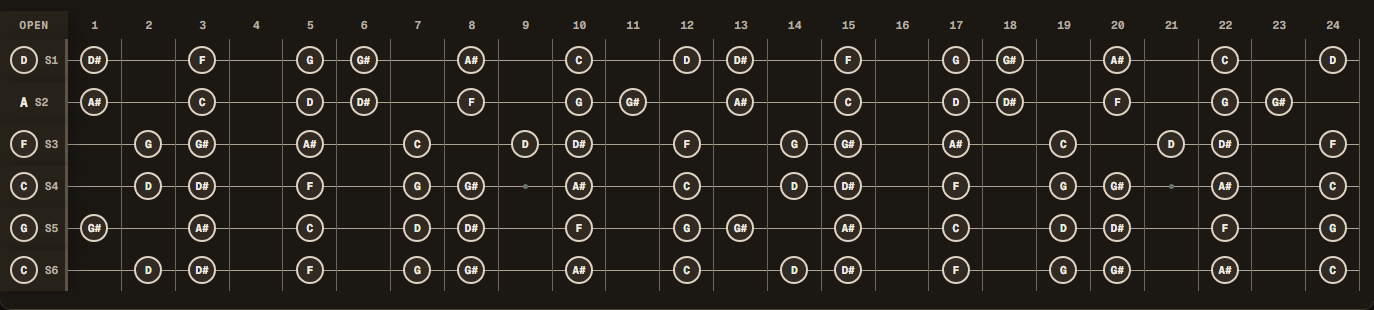
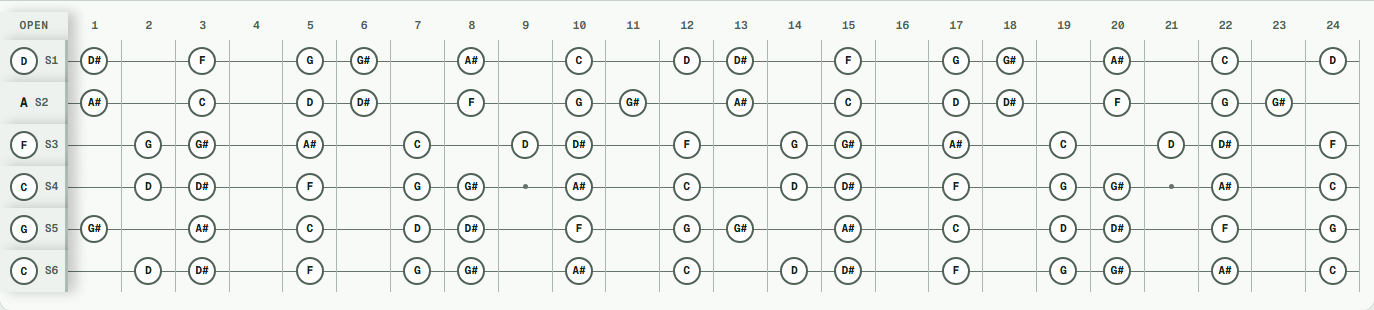
C Phrygian
C Phrygian places a flat 2 above the open root: C, D♭, E♭, F, G, A♭, B♭. Play the first-fret D♭ against the open C for the mode's half-step tension. For a major third with the same flat 2, try C Phrygian Dominant: C, D♭, E, F, G, A♭, B♭.
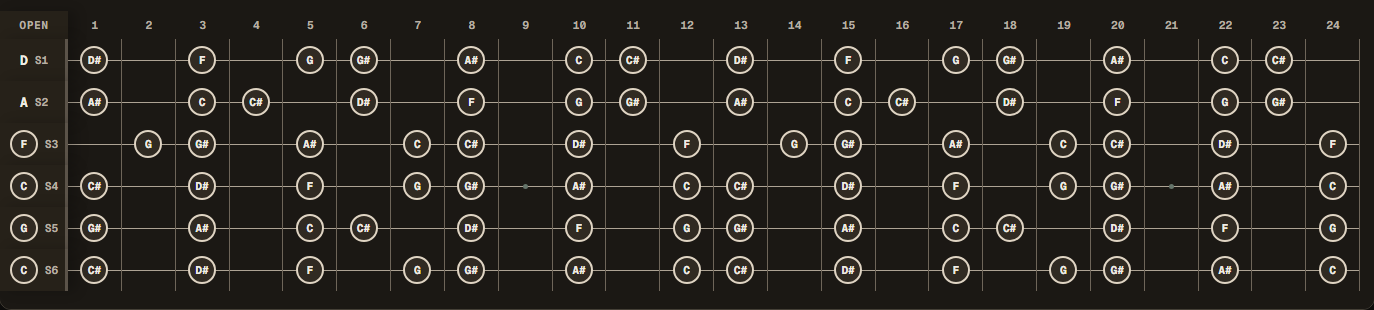
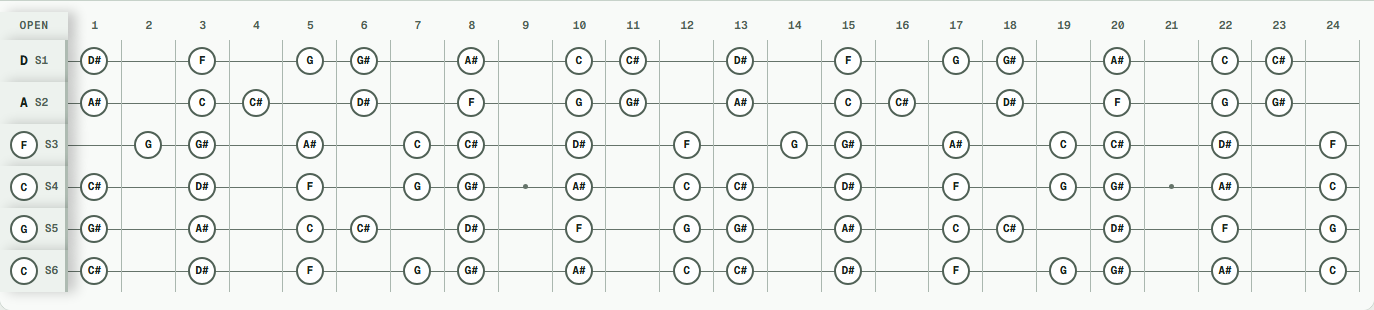
→ Map C natural minor in the Drop C visualizer
→ Map C Phrygian in the Drop C visualizer
Common Drop C progressions
Scroll sideways to see all columns.
| Roman numerals | Sounding chords | Low-string root frets | Use |
|---|---|---|---|
| i-♭VII-♭VI | C5-B♭5-A♭5 | 0-10-8 | Leave the open C between changes to create a pedal-tone rhythm. |
| i-♭VI-♭III-♭VII | C5-A♭5-E♭5-B♭5 | 0-8-3-10 | The roots outline C natural minor while one-finger barres keep the movement direct. |
| i-♭II | C5-D♭5 | 0-1 | The half-step move isolates the characteristic Phrygian tension. |
Original pedal-tone exercise
Set a metronome to 80 BPM and play eighth notes on strings 6–4 in this sequence: 0-0-0, 0-0-0, 3-3-3, 1-1-1. Return to the open C5 after each fretted chord, palm-mute the open notes, and let the fretted chords ring. The exercise practises one-finger accuracy, muting, and the C5-E♭5-D♭5 movement without borrowing a song riff.
String tension and setup example
The calculator's presets provide a reproducible comparison at a 25.5-inch scale. These are estimates based on pitch, gauge, scale length, and string construction; wound-string construction varies by manufacturer.
Scroll sideways to see all columns.
| Input | D Standard baseline | Drop C target |
|---|---|---|
| Tuning, low to high | D G C F A D | C G C F A D |
| Gauges, low to high | .052 .042 .030 .018 .014 .011 | .054 .042 .030 .018 .014 .011 |
| Estimated tension by string | 15.7, 18.3, 16.6, 14.8, 14.2, 15.6 lb | 13.5, 18.3, 16.6, 14.8, 14.2, 15.6 lb |
| Estimated total | 95.3 lb | 93.0 lb |
A .054 low C still produces less estimated tension than the baseline .052 low D. Use the string tension calculator to enter the actual gauges, scale length, and construction on your guitar before deciding on a set.
Drop C vs Drop D
Scroll sideways to see all columns.
| Feature | Drop D | Drop C |
|---|---|---|
| Tuning | D A D G B E | C G C F A D |
| Lowest open note | D | C |
| Power-chord shape | One-finger on strings 6–4 | One-finger on strings 6–4 |
| Upper-string reference | Standard tuning | Two semitones below standard |
| Setup impact | String 6 moves from standard tuning | All six strings are below standard pitch |
| Best fit | Quick switching with standard-tuned upper strings | Keeping Drop geometry in a lower overall register |
Decision rule: Choose Drop C when you want heavier low-end punch for metal and hard rock while keeping one-finger power chord mechanics. Choose Drop D if you need to switch quickly back to standard tuning on the same guitar without altering your string gauges or neck setup.
Visualize Drop C on the fretboard
- Open the preconfigured C5 and C natural-minor state below.
- Find C, G, and C together on strings 6–4 at fret 0 and fret 12.
- Switch the overlay from C natural minor to C Phrygian and locate D♭ at fret 1 on the low string.
- Add C5, B♭5, and A♭5 to the progression builder to map the i-♭VII-♭VI exercise.
Change the tuning to recalculate the chord and scale tones. You can then compare a shape without carrying over its standard-tuning note names.
→ Open Drop C with C5 and C natural minor
Common Drop C mistakes and troubleshooting
- Lowering string 6 to C from standard tuning. That produces C A D G B E. First tune all six strings down a whole step, then lower string 6 from D to C.
- Using standard chord names for unchanged fingerings.Shapes on strings 5–1 keep their geometry but sound two semitones lower. Name the chord from its sounding notes.
- Letting the low C ring through unrelated chords. Treat it as a deliberate pedal or mute it; an unwanted C can blur a chord whose harmony does not contain C.
- Solving loose feel with gauge alone. Check scale length, action, intonation, nut clearance, and playing attack.
Next steps
Strings 6–4 form C-G-C. Use that stack for one-finger power chords, then name fuller voicings from their sounding notes. Compare the same shape in Drop D, explore an added low string in 7-string Drop A, or test your own setup in the string tension calculator.
Sources and verification
All tuning intervals, chord structures, fret maps, and string tension calculations in this guide are verified through AltTuningLab's calculation engine and reference string standards:
- D'Addario String Tension Guide: Unit weight formulas (
UW = (T * 386.4) / (2 * L * F)^2) and measured tension tables used to calculate string tension at 25.5-inch scale length. - AltTuningLab Music Theory Engine: All fretboard intervals, note spellings, and chord voicings computed and verified against standard 12-tone equal temperament.
To report an error or suggest an addition to this guide, contact our editorial team via the contact page.