
7-string Drop A tuning is A E A D G B E, from lowest string to highest. It is standard 7-string tuning with the lowest B dropped to A, giving you the same root–fifth–octave relationship across the bottom three strings that suits Drop D and Drop C riffs. The six upper strings keep their standard layout. The low A needs clean muting and a gauge that suits your scale length. This guide shows you how to tune a 7-string safely, play low-register power chords, map A minor and Phrygian scales, and calculate balanced string tension.
7-string Drop A tuning notes
Standard 7-string tuning is B E A D G B E. Lower the seventh string by one whole step, from B to A, and you have A E A D G B E. The six higher strings stay in standard tuning, while the extra low A extends the guitar below the low E of a regular six-string.
Scroll sideways to see all columns.
| String | 7-string standard | Drop A | Change | Interval to next string |
|---|---|---|---|---|
| 7 (lowest) | B | A | −2 semitones | Perfect fifth |
| 6 | E | E | Unchanged | Perfect fourth |
| 5 | A | A | Unchanged | Perfect fourth |
| 4 | D | D | Unchanged | Perfect fourth |
| 3 | G | G | Unchanged | Major third |
| 2 | B | B | Unchanged | Perfect fourth |
| 1 (highest) | E | E | Unchanged | None |
Tune a 7-string guitar to Drop A
- Tune the guitar to B E A D G B E.
- Lower the seventh string from B to A.
- Compare open string 7 with open string 5: both are A, one octave apart. Their 12th-fret harmonics should preserve that octave.
- Play for a few minutes, retune, and check intonation and tuning stability on the low-A string.
This is a modest retune from 7-string standard, so it is convenient for players who switch between the two. The low string still benefits from a gauge and setup suited to its scale length and picking attack.
Drop A power chords and riffs
Strings 7, 6, and 5 are A, E, A: a root, fifth, and octave. Barre those three strings at the same fret for a compact power chord. Open is A5; fret 3 is C5; fret 5 is D5; fret 7 is E5; fret 10 is G5; and fret 12 is A5 again.
Strings 6–1 keep the familiar E A D G B E layout. Use the seventh string for a low pedal tone or one-finger power-chord slides.
Chords in Drop A
Chord shapes on strings 6–1 stay the same as they are in standard tuning. The new information is the seventh string: it is no longer B, so check any full seven-string voicing that includes it by ear and by note. Muting string 7 preserves familiar six-string chord grips; adding the open A can create a powerful bass pedal under A minor, A5, or modal riffs.
Check the low A against each chord. It reinforces an A chord, adds tension to some voicings, and muddies others. Leave space around the low register in a dense arrangement.
Scroll sideways to see all columns.
| Chord | Strings/frets, low to high | Notes | Why it works |
|---|---|---|---|
| A5 | 0-0-0-x-x-x-x | A-E-A | The open seventh, sixth, and fifth strings form root-fifth-octave. |
| A minor | 0-x-0-2-2-1-0 | A-A-E-A-C-E | The low A extends a familiar six-string A-minor voicing without adding a non-chord tone. |
| A major | 0-x-0-2-2-2-0 | A-A-E-A-C#-E | Moving the second-string note to C# supplies the major third. |
| C major | x-x-3-2-0-1-0 | C-E-G-C-E | Muting both low strings preserves the standard six-string C-major voicing. |
Scales for Drop A
A Natural Minor
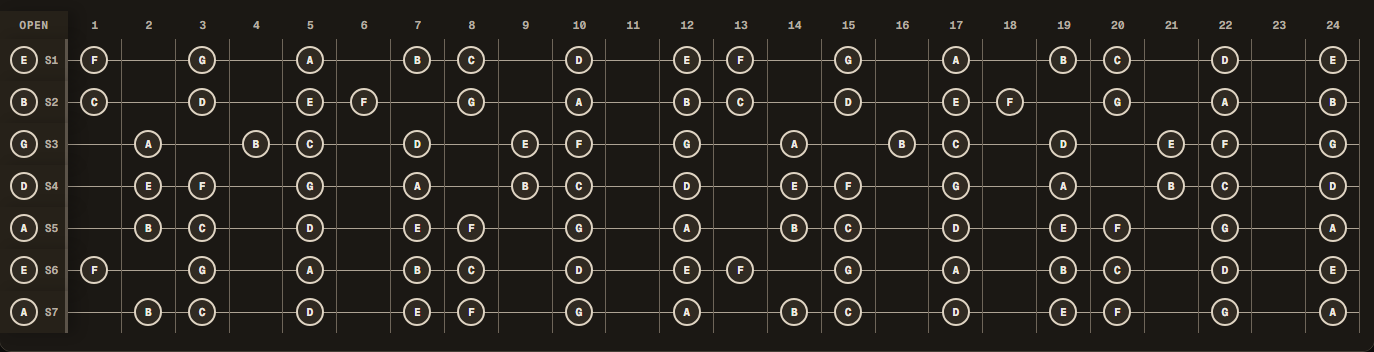
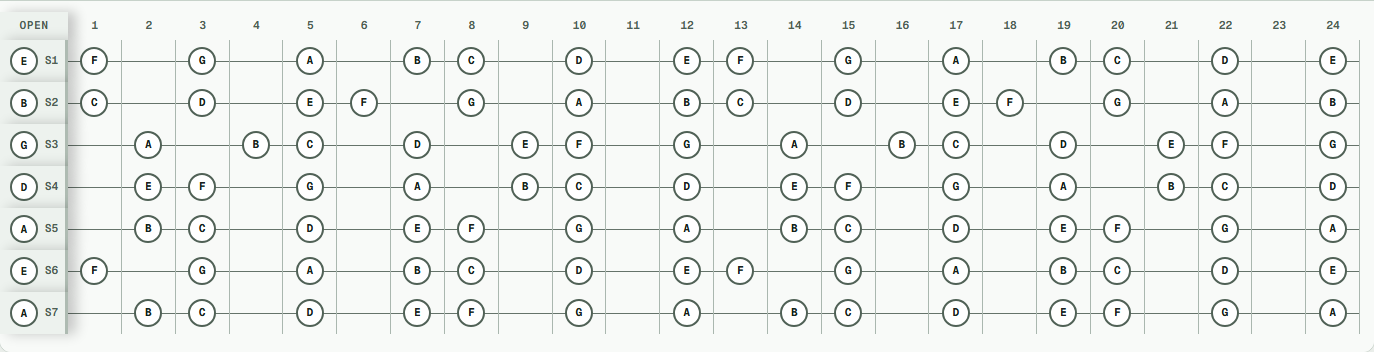
A natural minor contains A, B, C, D, E, F, and G. On the open seventh string the first octave is immediate: open A, fret 2 B, fret 3 C, fret 5 D, fret 7 E, fret 8 F, fret 10 G, fret 12 A. Use the open A as a tonal anchor while you map the rest of the scale across the standard-tuned six upper strings.
A Phrygian and Phrygian Dominant
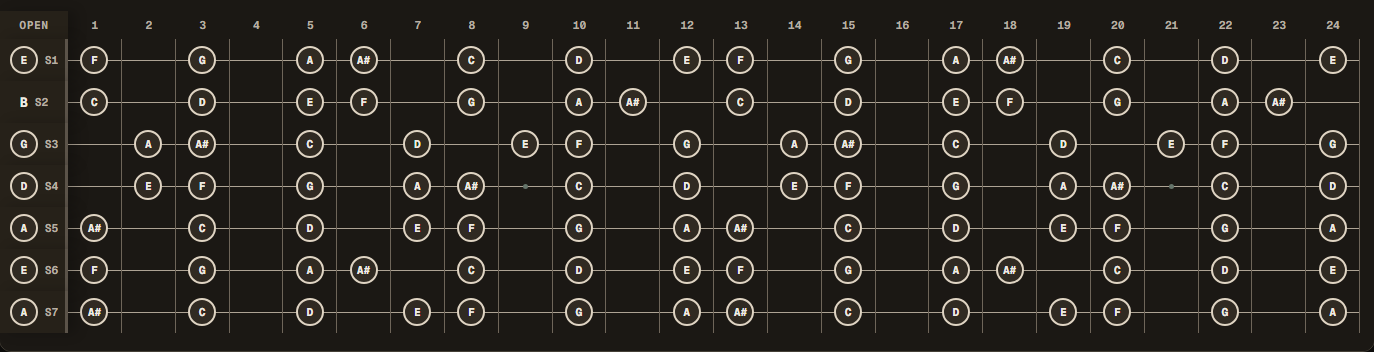
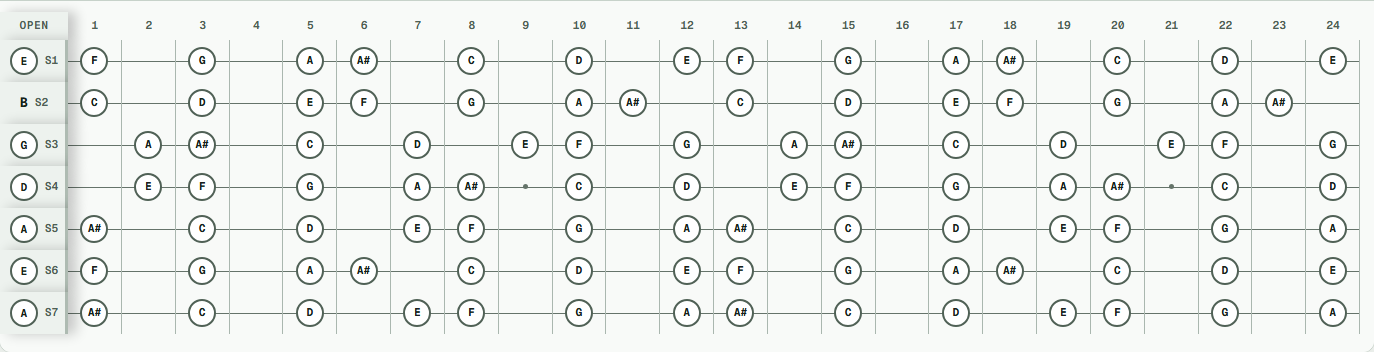
A Phrygian is A, B♭, C, D, E, F, G. The B♭ at fret 1 against the open A is the defining tension. A Phrygian Dominant changes C to C#, producing A, B♭, C#, D, E, F, G for a more exotic major-third color over the same low pedal.
→ Map A natural minor in 7-string Drop A
→ Map A Phrygian in 7-string Drop A
Common 7-string Drop A progressions
Scroll sideways to see all columns.
| Roman numerals | Sounding chords | Low-string root frets | Use |
|---|---|---|---|
| i-♭VII-♭VI | A5-G5-F5 | 0-10-8 | Use the open A between changes while the upper strings carry a separate melody. |
| i-♭VI-♭III-♭VII | A5-F5-C5-G5 | 0-8-3-10 | The roots remain inside A natural minor and fit the one-finger low-string shape. |
| i-♭II | A5-B♭5 | 0-1 | The half-step move isolates A Phrygian's characteristic low-string tension. |
Original low-string control exercise
Set a metronome to 75 BPM. Play four palm-muted eighth notes on open string 7, then one ringing three-string power chord at frets 3, 1, and 0, returning to four open-A notes after each chord. Keep strings 4–1 silent throughout. This A-C-B♭-A exercise practises seventh-string muting, even pick attack, and accurate one-finger barres without reproducing a song passage.
String tension and setup example
The calculator's 7-string presets give a reproducible comparison at a 25.5-inch scale. The figures are estimates based on pitch, gauge, speaking length, and construction, so wound strings from different manufacturers can produce different results.
Scroll sideways to see all columns.
| Input | B Standard baseline | Drop A target |
|---|---|---|
| Scale length | 25.5 in | 25.5 in |
| Tuning, low to high | B E A D G B E | A E A D G B E |
| Gauges, low to high | .059 .046 .036 .026 .017 .013 .010 | .062 .046 .036 .026 .017 .013 .010 |
| Estimated tension by string | 14.3, 15.5, 16.9, 15.7, 16.6, 15.4, 16.3 lb | 12.6, 15.5, 16.9, 15.7, 16.6, 15.4, 16.3 lb |
| Estimated total | 110.8 lb | 109.1 lb |
A .062 low A still produces less estimated tension than the baseline .059 low B. Enter your guitar's real scale length and string construction in the string tension calculator; longer-scale and multiscale 7-strings can produce a different balance.
Drop A vs 7-string standard
Scroll sideways to see all columns.
| Feature | 7-string standard | 7-string Drop A |
|---|---|---|
| Tuning | B E A D G B E | A E A D G B E |
| Lowest open note | B | A |
| Strings 6–1 | Standard E A D G B E | Standard E A D G B E |
| Low power chords | Two-finger shape | One-finger barre on 7–5 |
| Best for | Extended-range chord and lead work | Low-riff writing with familiar upper strings |
Decision rule: Choose Drop A when you want aggressive modern metal riffing with one-finger low-string power chords while keeping standard lead fingerings on strings 6–1. Choose 7-String B Standard when you play extended-range jazz, prog, or classical arrangements that require symmetrical four-fret fourth intervals across all adjacent bass strings.
Visualize 7-string Drop A
- Open the preconfigured A5 and A natural-minor state below.
- Inspect the A-E-A stack on strings 7–5 at fret 0 and fret 12.
- Switch the overlay to A Phrygian and locate B♭ at fret 1 on string 7.
- Add A5, G5, and F5 to the progression builder to map the i-♭VII-♭VI exercise.
The interactive map exposes all seven strings at once, making it clear where the dropped low string diverges while the six familiar upper strings retain their standard-tuning positions.
→ Open Drop A with A5 and A natural minor
Common 7-string Drop A mistakes and troubleshooting
- Dropping the sixth string instead of the seventh.String 7 is the lowest, thickest string. It moves from B to A; strings 6–1 remain E A D G B E.
- Using a full seven-string grip without checking the low A.Mute string 7 unless its A belongs to the chord.
- Letting the seventh string ring while you play above it. Use both fretting-hand and picking-hand muting when moving to the upper strings.
- Copying another player's gauge without scale-length context.Compare tension at your actual scale length and treat the preset as a starting estimate, not a universal recommendation.
Next steps
Drop A keeps standard E A D G B E on strings 6–1 and adds an A-E-A power-chord stack across strings 7–5. For a lower six-string alternative, explore Drop C; for the same Drop geometry at a higher pitch, see Drop D; and use the string tension calculator to model your own 7-string scale length and gauges.
Sources and verification
The 7-string intervals, chord voicings, scale maps, and string tension figures in this guide have been calculated and verified using standard physical constants and reference literature:
- Standard Pitch Frequencies: Low A1 (55.00 Hz) and B1 (61.74 Hz) fundamental frequencies mapped to standard A4 = 440 Hz equal temperament.
- D'Addario String Tension Guide: Unit weight equations (
UW = (T * 386.4) / (2 * L * F)^2) and measured wound string data used for 25.5-inch 7-string calculations. - AltTuningLab Music Theory Engine: All fretboard intervals, note spellings, and chord voicings computed and verified mathematically.
To report an error or suggest an addition, contact our editorial team via the contact page.