
The natural minor scale, also called the Aeolian mode, is the foundation of minor-key music on guitar. It is built from the formula root, 2, ♭3, 4, 5, ♭6, ♭7 and is the sixth mode of the major scale (A natural minor uses the same notes as C major). This guide maps natural minor, harmonic minor, and minor pentatonic scales across four popular tunings: Standard E, Drop D, 7-String B Standard, and 7-String Drop A. You will learn the exact fret positions, interval shifts, and harmonic roles of each scale so you can improvise and build chords in any tuning.
Minor scale formula quick reference
Compare the interval formulas and characteristics of the three primary minor scales:
Scroll sideways to see all columns.
| Scale | Formula | Notes in A | Key interval | Primary musical use |
|---|---|---|---|---|
| Natural Minor (Aeolian) | 1 - 2 - ♭3 - 4 - 5 - ♭6 - ♭7 | A - B - C - D - E - F - G | Minor 3rd (♭3), Minor 6th (♭6), Minor 7th (♭7) | Diatonic minor progressions, rock, metal, folk |
| Harmonic Minor | 1 - 2 - ♭3 - 4 - 5 - ♭6 - 7 | A - B - C - D - E - F - G# | Raised major 7th (7), augmented 2nd step | Neoclassical, metal leads, resolving to tonic over V7 |
| Minor Pentatonic | 1 - ♭3 - 4 - 5 - ♭7 | A - C - D - E - G | 5 notes (omits 2 and ♭6) | Blues, rock, metal riffing and vocal-like soloing |
The natural minor scale (Aeolian)
The natural minor scale has seven notes per octave. In the key of A, the notes are A, B, C, D, E, F, G. On a guitar in standard tuning, the three bass strings (E, A, D) provide the 5th, root, and 4th degrees, which gives the scale deep open-string resonance.
A natural minor in Standard E
In standard tuning (E A D G B E), A natural minor sits across the open strings and lower frets. The root notes on strings 6 and 5 are at the 5th fret and open string respectively, providing an immediate anchor for the first-position box.
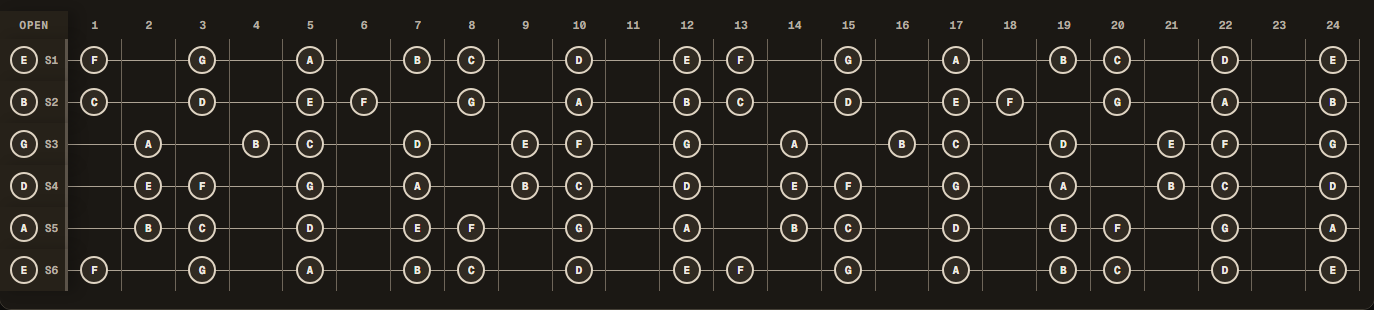
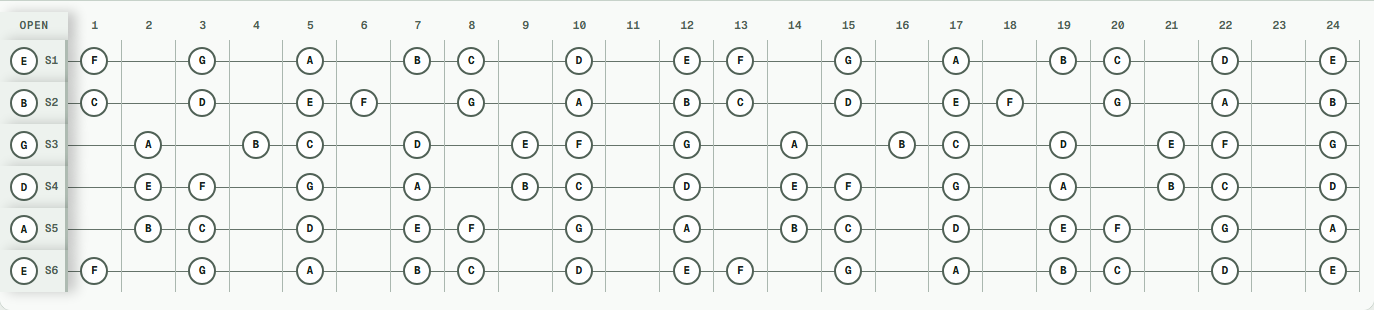
→ Explore A natural minor in Standard E with the interactive visualizer
D natural minor in Drop D
Drop D (D A D G B E) lowers string 6 from E to D. D natural minor (D, E, F, G, A, B♭, C) becomes the home minor key because the open bass string is the tonic. The scale shifts two frets higher on string 6 while remaining identical on strings 5 through 1.
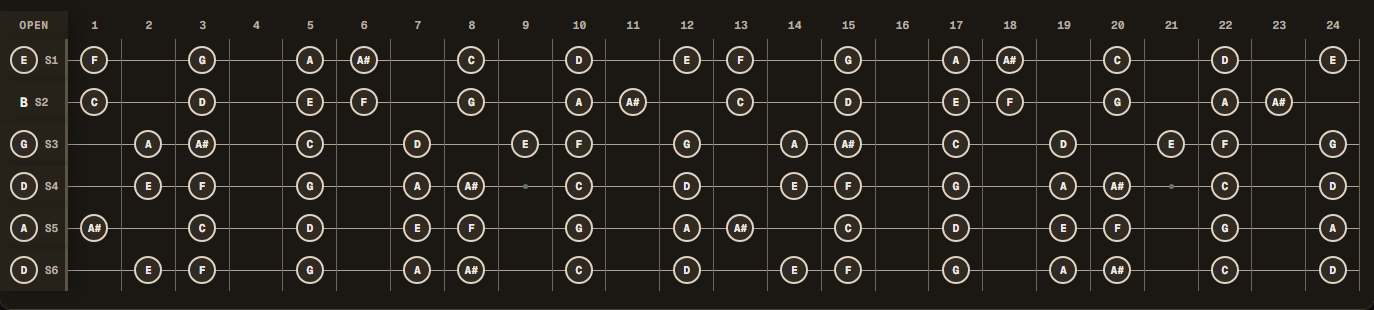
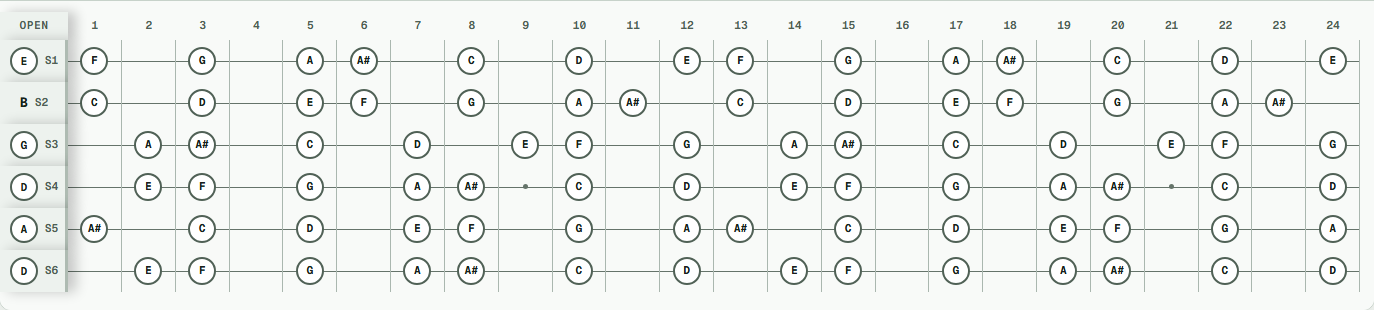
→ Map D natural minor in Drop D
B natural minor in 7-String B Standard
Standard tuning for a seven-string guitar (B E A D G B E) adds a low B string beneath the standard six strings. B natural minor (B, C#, D, E, F#, G, A) uses the low B as the root, giving you full three-octave scale runs starting from the open 7th string.
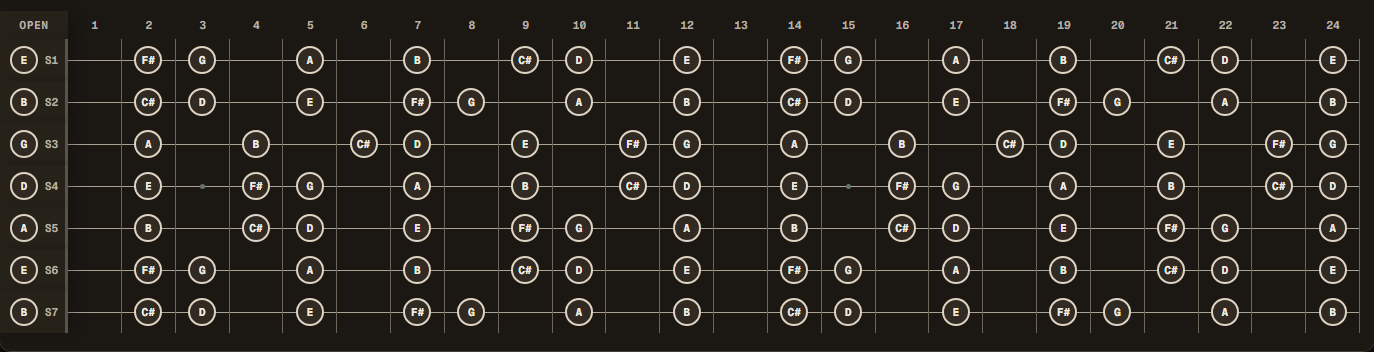
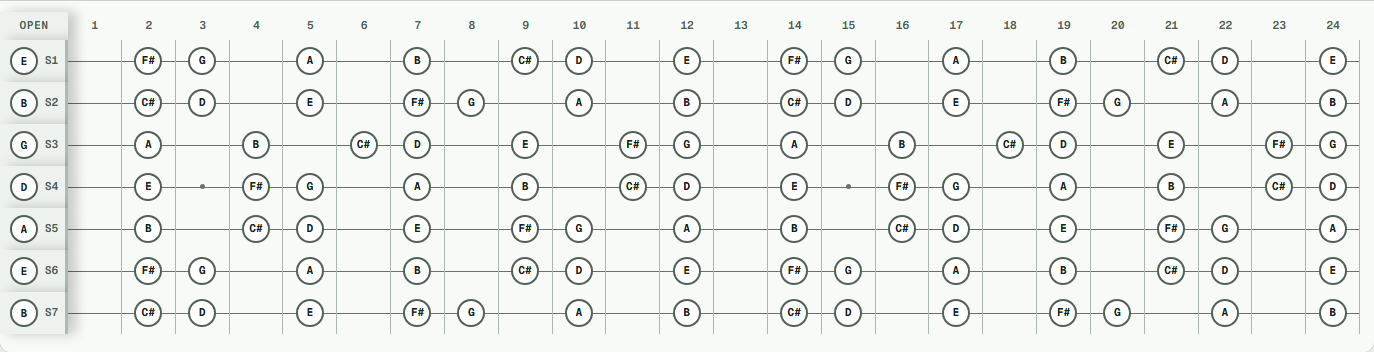
→ Explore B natural minor in 7-String B Standard
A natural minor in 7-String Drop A
Drop A (A E A D G B E) lowers the 7th string from B to A. A natural minor (A, B, C, D, E, F, G) benefits from having two A strings (strings 7 and 5) ringing as open tonic drones, anchoring heavy low riffs and octave patterns.
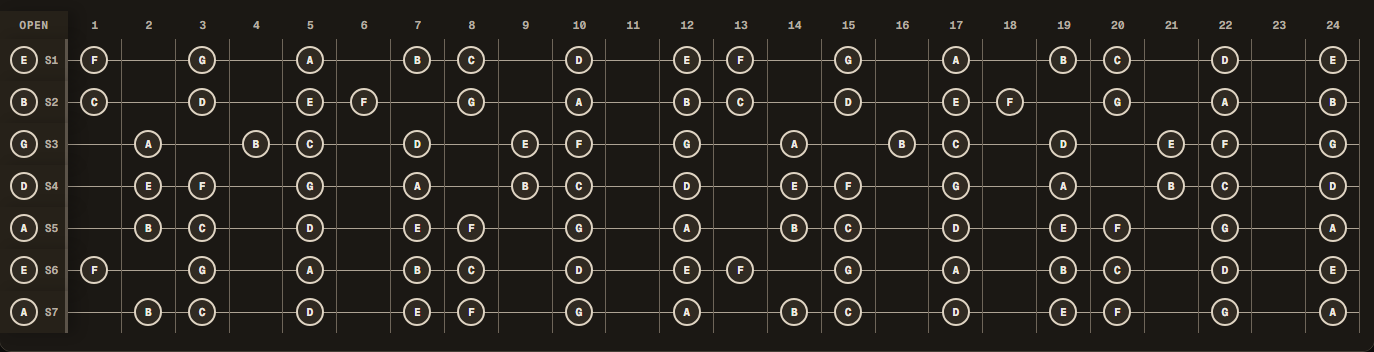
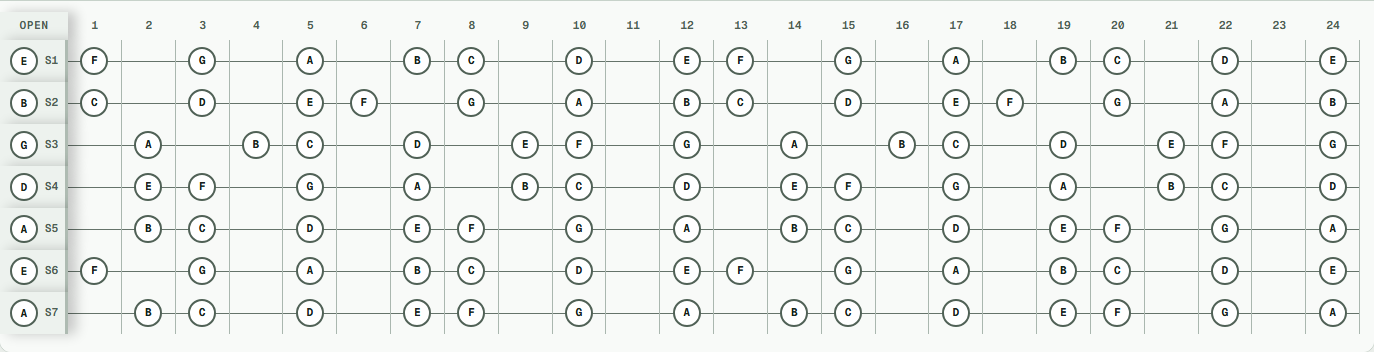
→ Map A natural minor in 7-String Drop A
The harmonic minor scale
The harmonic minor scale raises the 7th degree of the natural minor by a semitone, creating the formula root, 2, ♭3, 4, 5, ♭6, 7. In A harmonic minor, G becomes G#, producing A, B, C, D, E, F, G#. The augmented second interval between ♭6 (F) and 7 (G#) gives harmonic minor its distinctive tension and neoclassical sound.
A harmonic minor in Standard E
In standard tuning, G# sits on fret 4 of string 1, fret 1 of string 3, and fret 6 of string 4. The augmented-second step between F and G# creates a wide fretboard reach best navigated with linear three-note-per-string fingerings.
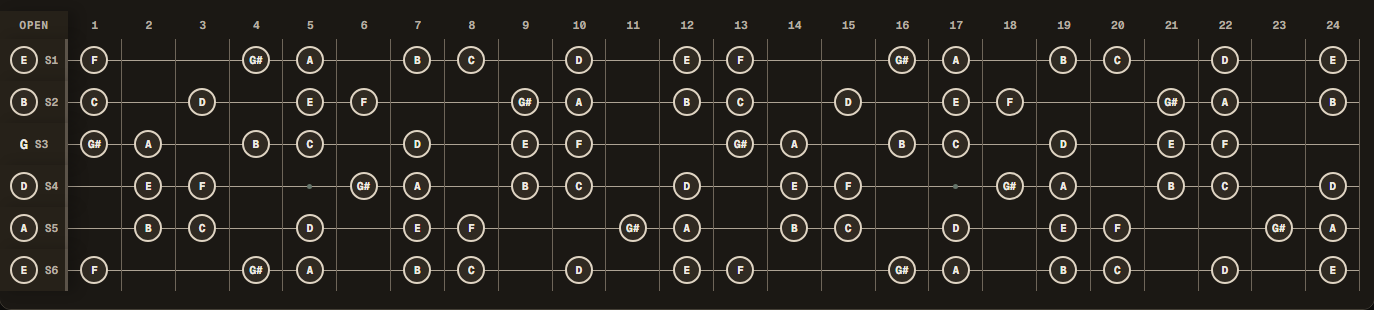
→ Explore A harmonic minor in Standard E
D harmonic minor in Drop D
D harmonic minor (D, E, F, G, A, B♭, C#) places the raised 7th (C#) on fret 4 of string 5 and fret 11 of string 6. The low open D string acts as a continuous drone while the sharp 7th provides sharp melodic tension that resolves up to the tonic.
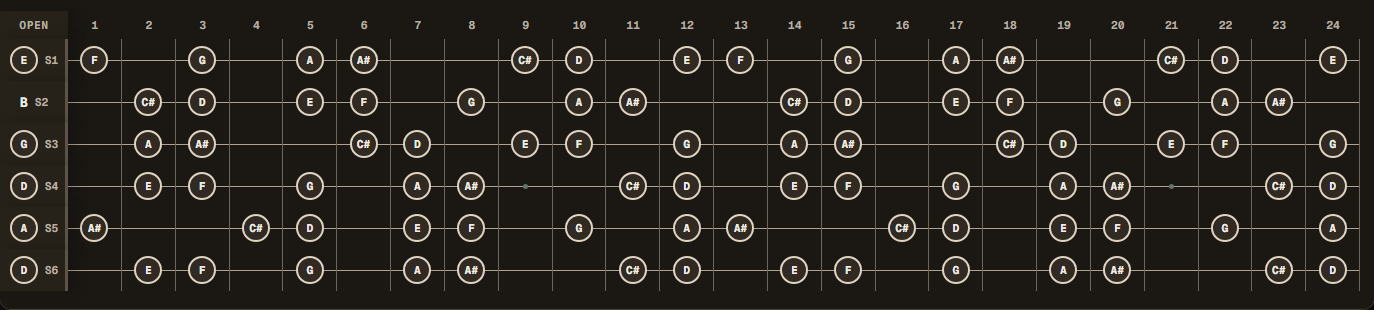
→ Map D harmonic minor in Drop D
B harmonic minor in 7-String B Standard
B harmonic minor (B, C#, D, E, F#, G, A#) gains low-register depth from the 7th string. The raised 7th (A#) is located on fret 11 of string 7, fret 6 of string 6, and fret 1 of string 5. This provides clean leading-tone access right above the open bass register.
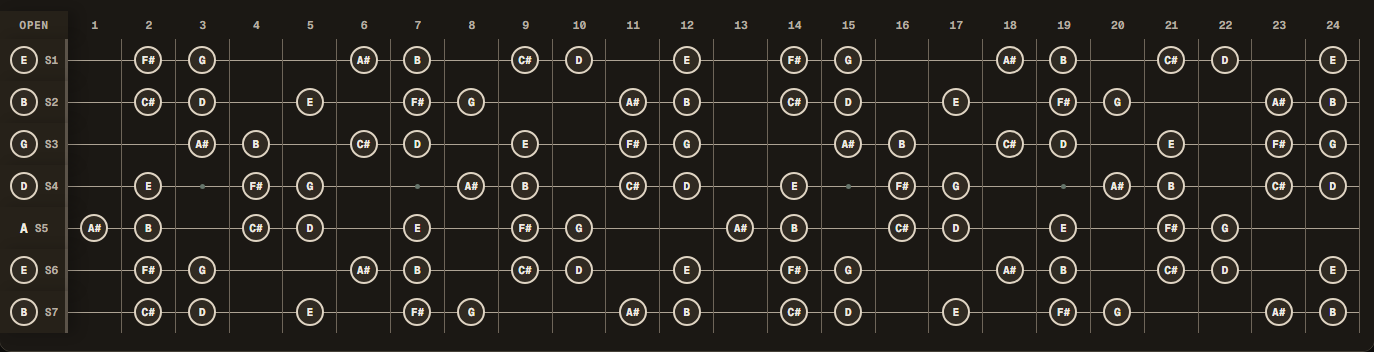
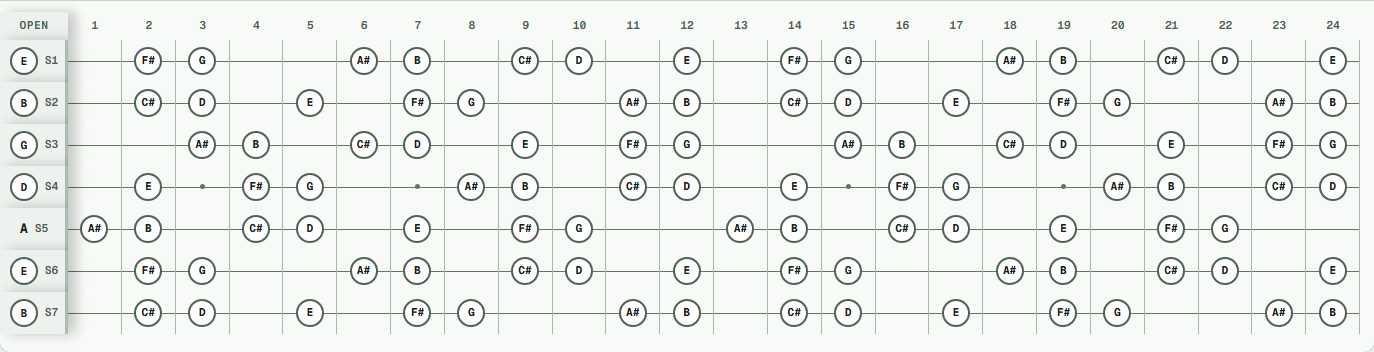
→ Explore B harmonic minor in 7-String B Standard
A harmonic minor in 7-String Drop A
A harmonic minor in Drop A (A E A D G B E) places the raised 7th (G#) on fret 11 of string 7 and fret 4 of string 6. The dual A strings (7 and 5) allow you to double the tonic while hitting the leading tone across lower octaves.
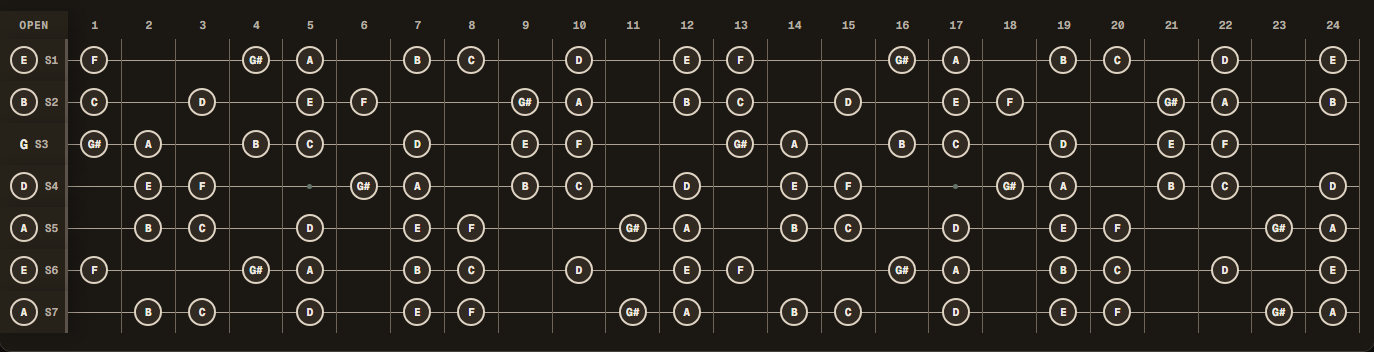
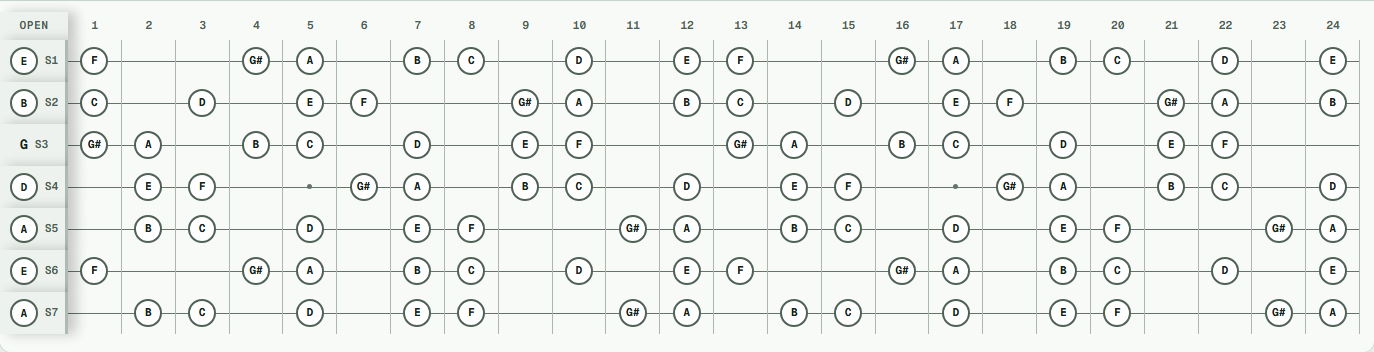
→ Map A harmonic minor in 7-String Drop A
The minor pentatonic scale
The minor pentatonic scale removes the 2nd and ♭6 degrees from the natural minor, leaving five consonant notes: root, ♭3, 4, 5, ♭7. In A minor pentatonic, the notes are A, C, D, E, G.
Because it omits the minor second intervals (between 2 and ♭3, and 5 and ♭6), every note sounds stable over minor harmonies. In alternate tunings such as Drop D or 7-string Drop A, standard pentatonic box shapes remain identical on all standard-tuned strings (5 through 1), requiring only a two-fret shift on the dropped bass strings.
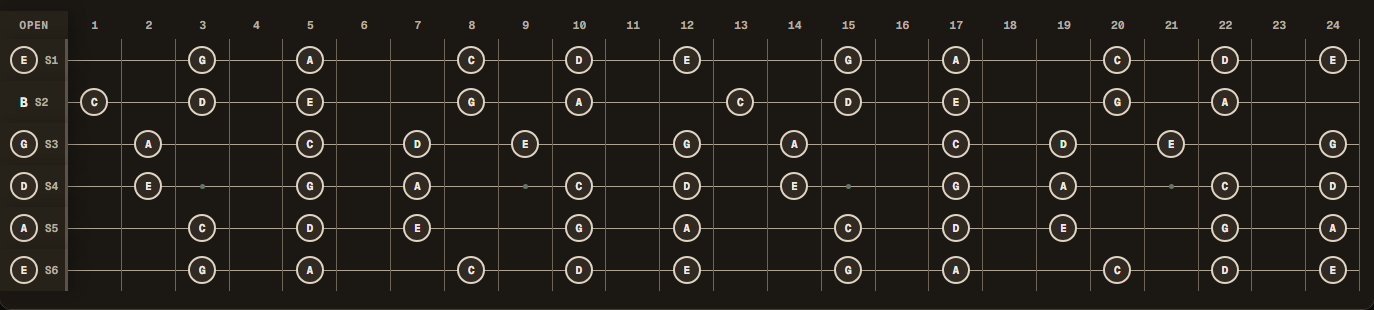
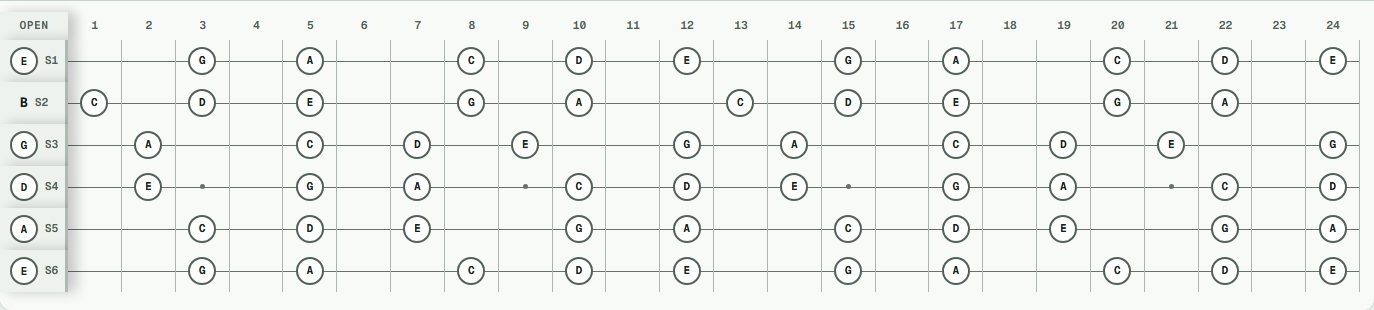
→ Explore A minor pentatonic in Standard E
Practical minor-key progressions and practice exercise
Use these practical minor progressions to hear how each scale interacts with chord harmony:
1. Diatonic Aeolian Progression (i – ♭VI – ♭VII – i)
Am – F – G – Am (in A minor) or Dm – B♭ – C – Dm (in D minor).
Use the natural minor scale over all four chords for consistent modal resolution.
2. Harmonic Minor Cadence (i – iv – V7 – i)
Am – Dm – E7 – Am.
Play A natural minor over Am and Dm, then switch to A harmonic minor over E7 to outline the G# leading tone.
Original practice exercise: Scale Degree Switching (80 BPM)
Set a metronome to 80 BPM. Practice switching between natural minor and harmonic minor over a steady pedal bass note:
- Measure 1 (Natural Minor): Play open string 5 (A), then pick fret 3 (C), fret 5 (D), and fret 7 (E) on string 5.
- Measure 2 (Natural Minor ♭7): Play fret 8 on string 5 (F), fret 10 (G, the natural ♭7), resolving to fret 12 (A).
- Measure 3 (Harmonic Minor): Play open string 5 (A), fret 3 (C), fret 5 (D), and fret 7 (E).
- Measure 4 (Harmonic Minor 7): Play fret 8 on string 5 (F), fret 11 (G#, the raised leading tone), resolving to fret 12 (A).
Skill focus: Hearing and feeling the one-fret difference between the natural ♭7 (G) and harmonic major 7th (G#).
When to use each minor scale
- Natural minor: Your default minor scale for rhythm playing, riff writing, and melodic soloing over standard minor chords.
- Harmonic minor: Use when soloing over a major dominant V or V7 chord in a minor key (such as E7 in the key of A minor), or to create neoclassical tension.
- Minor pentatonic: The most dependable scale for blues, rock, and metal improvisation. It avoids semitone clashes while locking directly into chord roots.
Common mistakes when learning minor scales
- Overusing harmonic minor over non-dominant chords: Playing harmonic minor over the ♭VI or ♭VII chord creates harsh dissonance. Reserve it for the V7 chord or dedicated neoclassical riffs.
- Forgetting string root shifts in drop tunings: When moving to Drop D or Drop A, the lowest string shifts down by two semitones. All scale degrees on that string must move up two frets.
- Relying entirely on box patterns: Learn single-string intervals (whole and half steps) so you can navigate across any alternate tuning without memorizing new boxed grids.
Visualize any minor scale with AltTuningLab
AltTuningLab recalculates the entire fretboard instantly when you switch tunings:
- Open the interactive fretboard visualizer.
- Choose your tuning preset: Standard E, Drop D, 7-String B Standard, or 7-String Drop A.
- Set the Scale Root to your desired key (such as A, D, or B).
- Select Scale Type: Minor (Aeolian), Harmonic Minor, or Pentatonic Minor.
- Inspect how interval positions shift across all strings up to the 24th fret.
→ Open the interactive minor scale visualizer
Next steps
Compare how minor scale shapes adapt across specific alternate and drop tunings:
- Drop D Tuning Guide: chords, scales, and progressions in D A D G B E.
- Drop C Tuning Guide: C minor scales and one-finger power chords in a lower register.
- 7-String Drop A Guide: extended-range chords and Phrygian modes.
- DADGAD Tuning Guide: modal Celtic drones and D Dorian scales.
Sources and verification
The scale formulas, modal intervals, and fret positions in this guide have been verified using standard 12-tone equal temperament calculations and reference music theory literature:
- Mark Levine: The Jazz Theory Book (Sher Music Co.). Confirms diatonic Aeolian and Harmonic Minor scale degree construction and functional V7 resolution.
- AltTuningLab Music Theory Engine: All fretboard intervals, note spellings, and multi-tuning coordinates calculated and verified mathematically.
To report an error or suggest an addition, contact our editorial team via the contact page.